Firstly, I have to write about what other scientists have thought and written about the teacher of the special school (henceforth special-teacher), mainly in Europe. Deinhardt and Georgens (1861, Germany) wrote a two-volume book about “how to teach handicapped children.” They say that the special-teacher’s duty is a “curative or medical education” (Heilerziehung). In Hungary we still use this name in its Hungarian version — gyógypedagógus (curative-pedagogy) — for the special-teacher.
A. R. Luria, in the Handbook of Mental Deficiency, calls the special teacher’s speciality “neurological compensation.” It means that the special-teacher’s work is educational rehabilitation, psycho-pedagogy, re-adaptation, compensation, correction, regeneration and education — while the normal teacher usually uses only the last of these, the education function.
After all these considerations — as a special-teacher myself — my personal opinion is that the special-teacher speciality is not just a kind of education or teaching method. This job is more habilitation and rehabilitation than teaching. It is not “only” teaching (to give suitable knowledge and information for students); it is a kind of life-style. The special-teacher works not only with school-age children, but sometimes begins work right after birth, with the early-developmental method, and continues teaching after school age as well, during adulthood.
A Three-Point Time Scale
This gives us a three-point time scale:
- Upbringing — teaching handicapped children after birth, not only from school age.
- Education — not ending after school age, continuing throughout the lifespan.
- Personality development — the main part of individual developmental theory during lifespan.
In the 1970s, Wolfensberger, Nirje, and Bank-Mikkelsen established a strategy for how to care for handicapped people during their lives. This concept is known as “Normalisation in Human Services.” Ever since, this way of thinking has influenced the whole of special education and still continues to do so. The eventual goal of this theory is to adjust these children into the larger society of non-handicapped before they leave school. After this, they may have a life as near normal as possible.
Special Education as a Complex Science
The other reason this job is special is that it has a close relationship with the sciences. During the last century, many sciences developed more than during the previous 500 years — for example, fifteen years ago we knew only a small number of neurotransmitters; in the last five years we have discovered many more and have gained much more detailed knowledge, which is why we call the last ten years “the decade of the brain.”
Because special education has a strong relationship with other sciences, new approaches have strongly changed it. It is enough to think about prenatal diagnosis, the period of the incubator, neurological results, psychological and sociological methods, and so on. This transition is still continuing, so special educators have to pay attention to all these sciences and use the new results to make the therapy and care of handicapped people more effective. We call this a “paradigm shift” during science development. This is all part of the special-teacher’s duty — the reason why they are different from the teachers of normal education. Figure 1 summarises this point.
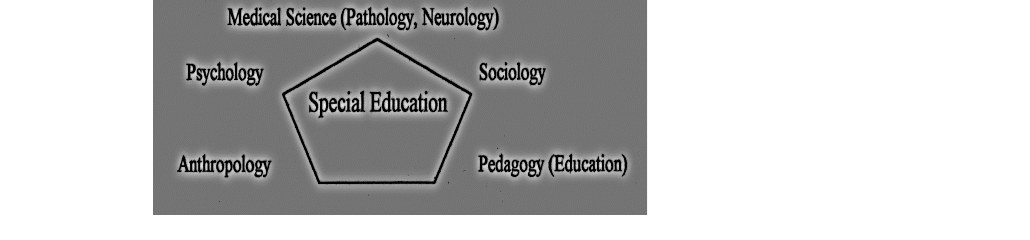
The special-teacher’s other speciality is that s/he has to perform a kind of academic work (educational approach) and therapeutic work (medical, psychological approach) at the same time. That makes the special-teacher a specially trained teacher, different from the normal teacher.
Seven Developmental Fields
Special education has to concentrate on the following seven developmental fields to create the best educational conditions:
- Behaviour
- Social skills
- Language skills
- Emotional skills
- Self-care skills
- Cognitive skills
- Academic development
To make all these possible, the special-teacher has to work together with others — doctors, psychologists, social workers, etc. (see Fig. 1 above) — to form a team and do teamwork. To create the best developmental plan for the child, and for the team to understand each other, the special-teacher needs a greater amount of knowledge about anatomy, neurology, pathology, psychology, sociology, and so on. It means they must have special knowledge of many different sciences, which is why their job name in English is “Special Education,” and why it is also called a “Complex Science.” In this case the special teacher’s work is to manage the teamwork and to make the developmental plan for the children together with the others on the basis of such knowledge — because s/he will be the one who carries out the effective therapy with the child.